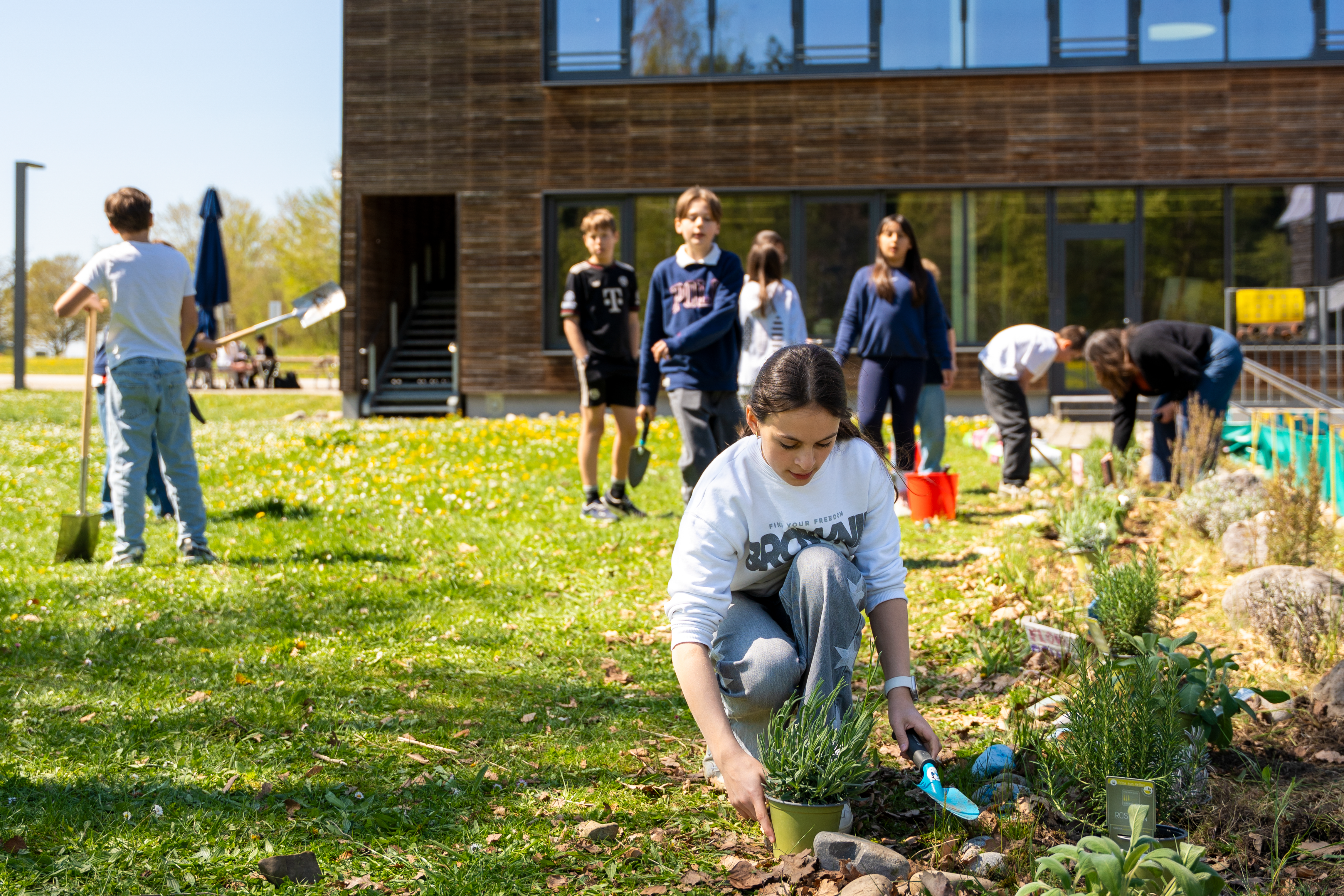
Earth Day at Munich International School (MIS) was a vibrant display of student-led environmental stewardship, featuring a wide array of activities designed to move beyond simple awareness toward systemic action. Activities were organized across all grade levels, driven by student passion and supported by the community.
Why Earth Day Matters: A Vision for the Future
To understand the deeper purpose of these celebrations, one must look at the educational philosophy driving them. Middle school educator and Changemaker Lead Kathryn Berkman emphasizes that the goal of such initiatives is to shift students from being passive learners to active creators of a better future. She writes:
"There is a jump that must be made from students who primarily focus on gaining knowledge and demonstrating that they know content or have skills to students whose purpose as learners is to ask questions to actively create a more sustainable and peaceful world. Fanning the sparks of curiosity is key".
Student Spotlights: From Healthy Bowls to Global Systems
Many of the Earth Day activity stations were spearheaded by students who have turned their personal concerns into community-driven movements. A prime example is Alina Schoeller, a 10th-grade student who founded Power People, a community food truck that serves healthy, affordable bowls, vegetable pots, curries, and soups to rural Bavarian communities like Schäftlarn, where access to balanced nutrition is often limited. Her Earth Day project aligned with her food truck's mission to educate younger people on nutrition and healthy ingredients.
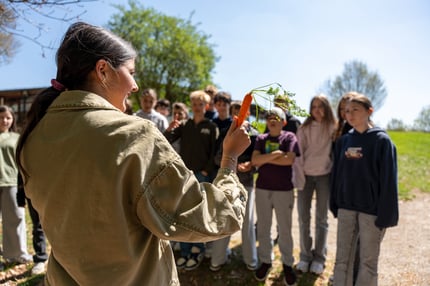
Similarly, younger students showcased their investigative work. Grade 5 students, led by peers like Logan, presented their findings on the "Hidden Cost of a Cotton T-Shirt," highlighting the 2,700 liters of water required for production. Their Earth Day contribution included a "Lost and Found" investigation, where they analyzed the environmental impact of abandoned clothing on campus to encourage more responsible consumption.
A Day of Hands-On Stewardship
The campus was transformed into a living laboratory with numerous interactive stations:
- Biodiversity and Nature: Students engaged in biodiversity mapping using the iNaturalist app, created seed bombs for a butterfly garden, and learned about local wildlife at the bat houses on campus.
- Creative Sustainability: Participants used fallen leaves and branches to create nature art, wrote entries for an MIS Earth Day poetry book, and practiced ceramic making.
- Active Conservation: A school-wide litter collection challenge aimed for "zero litter" on campus by the end of the day. Additionally, students participated in an "Electricity-Free Day," checking classrooms for unnecessary lights and electronics to reduce energy consumption.
- Sustainable Food Systems: Beyond Alina’s food truck, stations focused on planting mushrooms from spores, learning to reduce food waste through games, and planting vegetable seeds to take home.
Junior School Contributions
Supported by the Parent Teacher Verein (PTV), Junior School classes participated in their own week-long series of environmental tasks:
- Early Childhood: Planting sunflowers in pots
- Grade 1: Planting apple seedlings and conducting a campus clean-up
- Grade 2: Creating artistic images of nature
- Grade 3: Designing tree species identification signs for the campus
- Grade 4: Planting in jars at the Indoor Maker Space
By integrating these diverse activities—ranging from gardening to systemic analysis of the fashion industry—MIS continues to nurture a generation capable of identifying and solving the complex environmental problems of the future.